Skip to content

One Day in Yosemite

2013 January 30
Comments Off
by YosemiteSteve

Has anyone ever tried to imagine everything that happens on a typical summer day in place like Yosemite National Park?

On Tuesday, June 26, 2012  thirty filmmakers set out on this ambitious mission. What had started as a casual Twitter conversation a few months before was now finally happening. We had scattered ourselves throughout the park, from the Mariposa Grove to Tuolumne Meadows and spaces in between (map). About half of us could be found in and around Yosemite Valley: at Glacier Point, climbing Half Dome, at the top of Yosemite Falls, and even in the kitchen of the Ahwahnee Hotel (map). At over 1200 square miles, there were vast swaths of the park that we didn’t cover. That’s because our focus wasn’t the empty wilderness, but the popular roadside attractions that the vast majority of Yosemite visitors experience.

From thousands of photographs and hours of footage, we created this window into One Day in Yosemite.

Of course, we weren’t really sure what would happen that day or how we would put it all together. “We’ll find the story in post!” was our joking mantra for the project. We did “create” some situations, such as working with the hang glider pilots, or arranging for Sean Jones and his son M’so to climb Cathedral Peak, but many things just popped up, like the helicopter rescue on Half Dome. (All shooters had a standing order that if they saw a helicopter, SHOOT IT!) Other avenues turned into dead ends, such as the bear-chasing wildlife biologist who never saw a bear, or the group of students from Dunbar, Scotland who were following in John Muir’s footsteps.

Our ambitions were high. Originally we hoped to produce a 40 minute documentary, but after reviewing footage and seeing what we did and didn’t get, we decided to set the bar a little lower, aiming for something under 20 minutes. I spent probably two full months off and on this fall and winter editing the project, and it was only when I gave up the idea of a traditional documentary and started thinking of it as more of an art-doc that things began to fall into place. I was amazed that I was able to whittle it all down to under 15 minutes, keeping it quick and snappy and hopefully leaving the viewer wanting more.

As part of the Yosemite Nature Notes series, this project was primarily funded by the Yosemite Conservancy, a partner of the National Park Service in Yosemite. Since this was such a complex project, we also received support from Kessler Crane for many of the time-lapse shooters who used their awesome gear, and BorrowLenses.com provided dozens of cameras, lenses and other gear.

From concept to completion, my partners in crime on this endeavor were Ryan Christensen and Jonah Matthewson from Bristlecone Media, but the biggest thanks goes to all the shooters who worked day and night to get the shot. Way to go Chris, John, Julie, Andrew, Sheldon, Ryan, Jonah, Ryan, Gustaf, Cody, Shawn, Vanessa, Dustin, Colin, Alex, Brian, Matt, Joe, David, Ryan, Ed, Chaz, Jim, Kris, Garrett, Daniel, Josh, Kristin and Jeff! (whew!) This project couldn’t have been done without all of you!
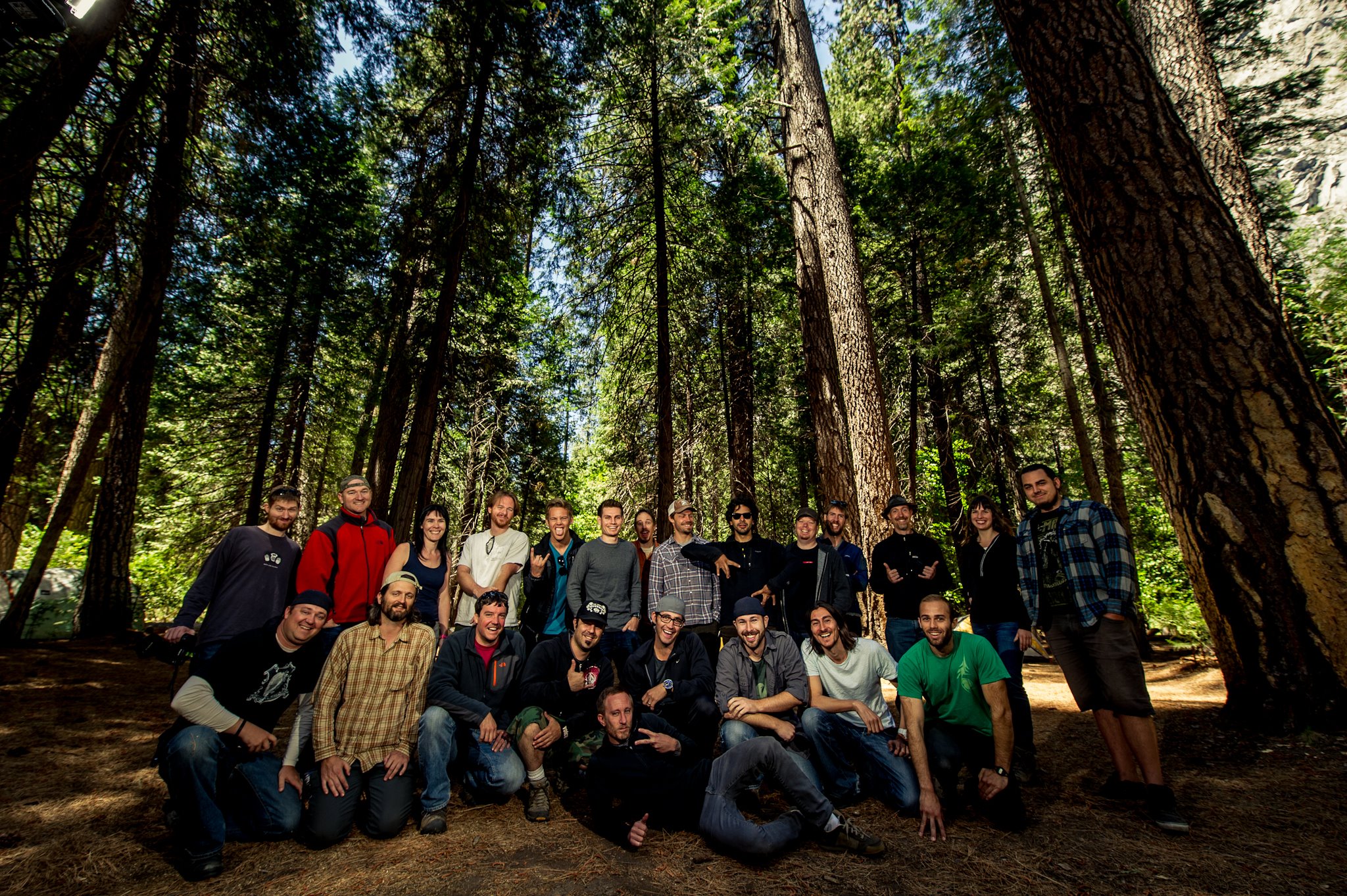
click to embiggen

Since it was posted to YouTube, it’s already been a smash hit, with nearly 50,000 views in the first week, and I’ve been blown away by many of the comments that I’ve read online. After watching, many viewers talk about the spirituality of Yosemite, and several have said that the film brought tears to their eyes. People who have spent a lifetime exploring the park were reminded of past visits, and those who have never been are planning their own adventures.

As of today, the video has been shared by the Atlantic, Grist (“The Yosemite video to beat all Yosemite videos.”) and the Huffington Post, but my favorite write-up comes from Peter Koch at the Active Times:

“Its 15 minutes tell a deeply human story of one of America’s greatest wild, natural places, and does an awesome job of weaving the two seemingly-at-odds storylines together in a way that reflects what the whole National Parks system represents: Humanity and nature as codependents working together for mutual preservation.”

It makes me very happy to think that we just might have pulled that off. Good work, team!
Shooting Underwater in the Virgin Islands

2012 December 19
Comments Off
by YosemiteSteve

Cinnamon Bay, Virgin Islands National Park

Tropical Vacation

After a pleasant Thanksgiving in New England, Athena and I spent a week exploring and snorkeling in Virgin Islands National Park on St. John, USVI. Even though this was truly a vacation and NOT a work trip, I did bring along two GoPro point-of-view HD video cameras & accessories to document the fun. These are the small, rugged and low priced cameras that are used in many action sports mounted to helmets, bikes, skis, etc. Two weeks earlier, I had found a brand new Hero 3 Black Edition at a Best Buy in Gilroy, California. I’d gone to nearly ten Best Buys that week to finally find the Black Edition, which was not officially shipping yet! I could have shot the whole trip with just the Hero 3, but since it was a newer camera, I wasn’t sure about power draw or access to electricity that I’d have on the trip, so I also brought my Hero 2 as a back-up that I mainly used as a surface camera. Even though all GoPro cameras are water-proof, many folks don’t realize that the Hero 1 and 2 can’t really shoot underwater due to the curved plastic lens cover. GoPro just released a new underwater housing for these older cameras, and it’s included with all the new Hero 3′s.

For Camera Nerds

With two exceptions, all footage was shot at 1080p, some at 30 frames per second, but most underwater footage was over-cranked to 60 fps (which you also can’t do on a Hero 2.) Once it was slowed down, it really helped stabilize the handheld swimming shots and added a little slow motion grandeur to the action. There are two shots that are 720p 120 fps, which really helped stabilize my jerky underwater movements, but definitely made things a little too soft. The camera can also shoot 2.7K and even 4K footage, but at only 15fps, which seems strangely impractical. I didn’t use any of these settings on this trip, but I will play with them more in the future. In particular, I’m wondering if 2.7K 30p footage could be zoomed in and stabilized in post, and if this would be better than just over-cranking the 1080p. I think in the future, I will most likely run this camera at 1080p 60 fps for most work.

Since I was also concerned about running out of memory and power, plus buggy firmware (this was a VERY new camera),  I did NOT shoot with the new ProTune setting. In retrospect, I regret this decision, mainly for the variations in white balance that happen underwater, at different depths and as clouds passed between the sun and water. With ProTune, I could have locked the white balance instead of having it always running on auto. This was my first time shooting video underwater, and since I didn’t bring a computer on the trip, I wasn’t able to look closely at the footage in the field, and I hadn’t considered how variable the light would be, especially as I dove down to 20 or more feet.

Camera Support

My favorite thing on this shoot was a camera mount made from a spring-loaded clip and a small ball-head. I clipped it to numerous vehicles and structures for both video and time-lapse, and it also made a decent handle for hand-held shots. For underwater shots, especially at depth where I couldn’t stay for long, I clipped the camera to a flat rock which I set down in front of some awesome scene and swam away. Eventually, the spooked fish would return, and I’d let the camera roll for a couple of minutes before going back down to retrieve the camera. I really think these shots do the best job of conveying the underwater world of Virgin Islands National Park.

The Night Skies of Yosemite National Park

2012 September 10
by YosemiteSteve

After spending three summers shooting time-lapse of Yosemite’s night skies, I finally got around to putting them all together for a new episode of Yosemite Nature Notes. When I bought a Canon 5D Mark II back in 2009, it was the first camera that I’d ever owned that allowed me to shoot astro time-lapse, so I began capturing the wonders of the universe that can be seen from Yosemite National Park. Like many shooters, I often focused on the incredible “clouds” of the Milky Way near Sagittarius, often puting a rock or a tree in the foreground for interest. Eventually, I realized that these types of images were becoming pretty generic, so by 2011 I began to focus on the bigger landscape of the park, trying to create shots that really said “Yosemite.” Taking advantage of a 50% waxing moon about a week before full, the moonlight would set on Half Dome or other landforms, illuminating the landscape and yet still providing enough darkness to see the stars.

 After my Moonbows episode came out in 2011, I used YouTube’s powerful analytics to learn that viewers found the time-lapse shots of photographers more interesting than the actual moonbows, so I then decided to include more people and telescopes at the Glacier Point Star Parties. Finally, in August of 2012, I got my last interviews, picked up a few more Star Party shots, and with the help of climbing-bum/editor Jeff Lodas, knocked out the edit in about a week.

So far, this episode has been a smash hit, with over 100,000 views in its opening week, more than any previous episode has experienced. It may take a while before it breaks 4 million like Frazil Ice, but I do feel that this is one of the strongest episodes yet.

Enjoy!

Interview on Borrow Lenses blog

2012 May 25
by YosemiteSteve

I was recently interviewed by Sohail Mamdani from Borrowlenses.com about my journey from photography to filmmaking and my current work in Yosemite and other parks. Give a listen and you’ll learn several secrets from my past, as well as my current thoughts on cameras, hardware and filmmaking in general.

http://www.borrowlenses.com/blog/2012/05/blcast-episode-2-an-interview-with-steve-bumgardner/

Water in Yosemite

2012 May 19
by YosemiteSteve

It was a crazy wet season in Yosemite and the Sierra Nevada this winter. Crazy as in crazy dry. Tioga Pass opened up two weeks ago, after being closed for only 4 months, perhaps the shortest seasonal closure in the history of the pass. My hopes of producing a new episode of Yosemite Nature Notes about skiing in Yosemite were dashed on the rocks that continued to poke through the thin snow. So after a 5 month literal and figurative drought, I finally came out with a new episode this past week, just in time for this years meager spring run-off.

Fortunately, I had plenty of big water footage on hand from previous seasons, especially last years amazing flows and floods in Yosemite Valley. This new episode is perhaps the most “interpretive” and thematic of all eighteen YNN’s, and I really wanted to focus on what happens to the water of Yosemite AFTER it flows out of the park. I hope that viewers will watch, learn and re-connect with Yosemite when they take a drink of water in the their homes or enjoy a strawberry or almond that was most likely grown with water from the Sierra Nevada.

Horsetail Fall, the Natural Firefall

2012 February 11
by YosemiteSteve

One year ago, I was intensly focused on capturing orange light on the ephemeral Horsetail Fall in Yosemite Valley. Pouring off the side of El Capitan, this seasonal waterfall attracts thousands of photographers every year in February when it is transformed into a natural “firefall” right before sunset. Last year, we had a fair bit of weather during the two week window that the firefall effect takes place, so getting good shots was a little tricky. I was trying to get a new episode of Yosemite Nature Notes out about  this phenomenon as well as the original man-made Firefall from Glacier Point. I never really got the “money” shot that I was hoping for, but the episode was saved thanks to fellow filmmaker Sterling Johnson, who let me license a few shots from his collection. I also interviewed Michael Adams, son of Ansel, Tony Rowell, son of Galen, and local photog Michael Frye, whose blog is a great source of information about photographing Yosemite.

We’ve had an extremely dry winter, so I haven’t been too optimistic about there being much water in the fall this year, but that may be changing. A new storm is rolling in, and the forecast calls for a couple of inches of snow for Yosemite Valley. Provided that it clears up after the storm, this should be enough snow to get the water flowing, so I’ll be out in Valley later this week, trying to get a few more shots for my library.

Yosemite Nature Notes – Winter Moments

2012 January 4
by YosemiteSteve

For the last days of 2011, my wife Athena and I headed from Yosemite Valley over the mountains to historic Benton Hot Springs to camp and soak. We went over Tioga Pass, down Lee Vining canyon and past Mono Lake, heading toward the north end of the White Mountains near the state line with Nevada. Tioga Pass, the highest paved road in the Sierra, is just under 10,000 feet, and on most years, the first snows of November will close the road for up to 7 months.  Since Halloween however, I’ve made several of what I thought would be “one last” trips over Tioga Pass only to find that it never really snowed and it never really closed.

After a record breaking dry December, when no recorded precipitation fell in nearby Fresno, the pass is still open and Yosemite Valley has been enjoying sunny days in the high 50′s. Throughout the park, even up on 13,000 foot Mount Dana, there’s just not much snow in sight. Perhaps I chose the wrong year to make a Yosemite Nature Notes Special Feature about winter!

Thankfully,  I’ve been shooting winters in Yosemite for a few years now on a variety of cameras, such as the Sony Z1, Canon A1, Sony V1U, & my current Sony EX1R. This new production was mainly an exercise in digging through tapes and hard-drives to find my best winter shots, and trying to match up this disparate footage with color correction and sharpening. Since I didn’t spend time shooting, I focused on the task at hand: creating a short, 3-minute art piece, basically a music video, that’s my Valentine to Yosemite winter lovers everywhere who are patiently waiting for the first flakes to fall.


MintyCam: A Pinhole Camera from an Altoids tin

2011 December 5
tags:
by YosemiteSteve

A few weeks ago, in the middle of whole bunch of camera hype, I decided that I’d like to play around with a pinhole camera again. Instead of dicussing sensor sizes, frame rates and power consumption, I’d go back to the roots of photography: a light-tight box, a piece of film and a simple aperture. I’d built a few pinholes back in the day, cameras that were designed to use black & white print paper as the “film” stock, which of course generates a negative image.

For over ten years now I’ve had several rolls of slide film sitting in my fridge and also the corresponding pre-paid processing mailers. I thought that a pinhole camera would be a neat way to finally use this film. At first, I assumed that I’d make my own camera, using a cookie tin or a cigar box.  That was before PetaPixel turned me on to the MintyCam from Chris Keeney.

It was perfect! Small, easy, cheap. I ordered one and a roll of opaque black tape used to mount the film roll. Chris was also nice enough to send me some extra copper foil so I could play with different sized pinholes, and included a small tripod mount on the bottom of the tin. With this gear in hand and one of my trusty tripods, I headed up the Tioga Road in Yosemite.

I was using Fuji Sensia 100 slide film, which has very little exposure latitude, so I bracketed my exposures between one and three seconds in the full sunlight. The handy little magnet/shutter was easy to pop off, count, and pop back on again without shaking the camera. I blasted through a few rolls, and sent the film off to the lab later that week.

Ever since going digital about ten years ago and getting that immediate feedback, I’d forgotten how exciting it was to wait and see what I’d captured!  I checked my mailbox anxiously for days until I finally got the film back. Just the smell of the emulsion took me back in time. I held the film up to the light, cut it into the individual images, and scanned them on my flatbed scanner. Here are some of the highlights:

Dana Fork of the Tuolumne River

Pine & Boulder, Olmsted Point

Shooting Timelapse, Tuolumne Meadows

Do Not Contaminate

It turns out that one second was generally the proper exposure for my sunny subjects. The shallow tin makes for a pretty wide angle image, probably around 14mm equivelant, so there’s some fun distortion. I’m suprised how sharp the image actually is, considering that it’s just a hole! Chris uses a tiny drill instead of a needle, so the .006″ diameter hole is very round, which increases sharpness. The only way to get a sharper image would be to have the hole laser cut.

I own dozens of film and digital cameras and I’m definitely a tech-y gear hound, but there’s a simple joy in taking a step back and using this very basic technology. I really like the shape of the image on the film strip and of course the sprocket holes are a cool retro artifact. I look forward to playing around more with the MintyCam and will probably try building a few other cameras this winter, but I’d better hurry. This sad note was included with the processed film: “We must inform you that due to industry shifts and demand, A&I will no longer process E6 film as of December 23, 2011.”

I’ve still got about ten of these pre-paid film processing mailers laying here so I better get shooting!

Yosemite Nature Notes – Episode 17 – Black Oaks

2011 November 9
by YosemiteSteve

After a final editing push and a few technical hiccups, I’m pleased to announce that I just completed the newest episode of Yosemite Nature Notes. This one features my favorite tree in Yosemite Valley, the Black Oak, showing the tree in its various seasonal moods, and also telling the story of the mighty acorn and the importance that this seed plays in the lives of animals and people. I’m excited to have three people making their YNN debut in this one, in particular Julia Parker, basket weaver, acorn pounder and cultural demonstrator extraordinaire.


I’d like to thank Erik Westerlund and Bill Kuhn for appearing as well. This episode is my most collaborative production yet. I had editing help from my good friend Ryan Christensen, Brent Bain from Yosemite Valley composed a great new piece of music, and as always, Josh Helling helped me get some of the great shots of these awesome trees. I hope you like it!

One last jaunt up into the mountains.

2011 November 1
by YosemiteSteve


Checking out oxidized glacial polish at Cathedral Lake. photo by Shawn Reeder

Cathedral Lakes, near Tuolumne Meadows In Yosemite National Park is a favorite high country destination for many park visitors. Yesterday, my friend Shawn Reeder and I took one last run up there to pick up some shots for an upcoming episode of Yosemite Nature Notes. I brought my camera, tripod and a 5-foot Kessler Crane CineSlider to get some sweet shots of Cathedral Peak and the area around the lakes. Here’s a video blog about our trip.

Shawn and I busted this out in half a day, leaving the car at about 12:30 and getting back before 7:00 with just enough light that we never even pulled out our headlamps. My pack weighed around 45 pounds, and my hips were a little sore after the six mile round trip, but I’m glad we made it up there before this next storm rolled in!